
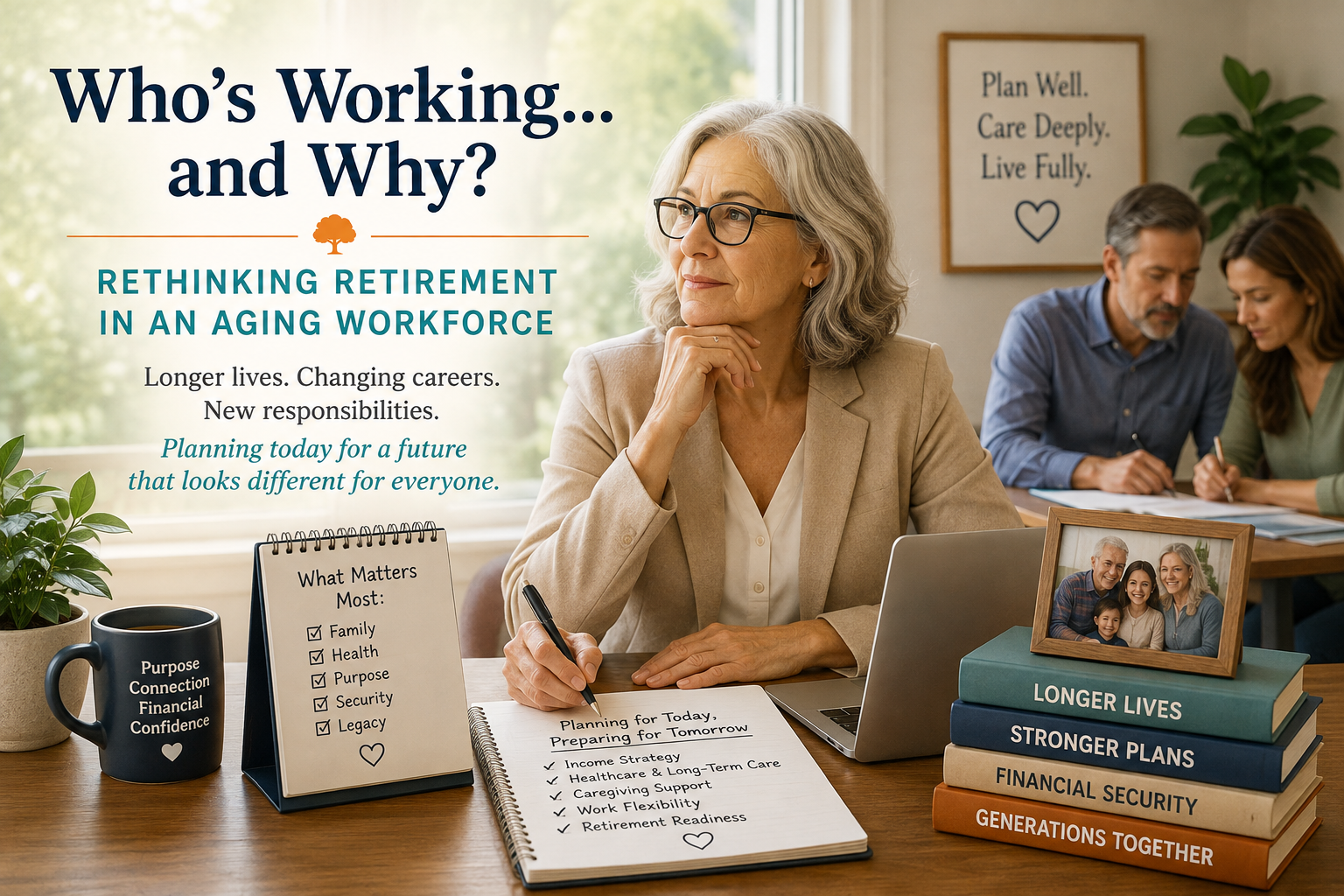
Who’s Working… and Why? Rethinking Retirement in an Aging Workforce
Retirement Strategist Carroll Golden
If you are a financial professional whose focus is retirement planning, there is a workforce trend we cannot afford to ignore.
People are working longer.
But that simple statement doesn't tell the whole story.
The workforce is aging, retirement is becoming less predictable, and more employees are balancing work with responsibilities that previous generations may have encountered at different stages of life. For advisors, employers, and families, that changes the retirement conversation considerably.
The question is no longer simply, “When will you retire?”
It is becoming:
“What does working, caregiving, and eventually retiring actually look like for you?”
The Workforce Is Getting Older
Research from the Employee Benefit Research Institute highlights an important shift in the age composition of the workforce.
Workers age 65 and older now represent a considerably larger share of the older workforce than they did at the beginning of this century.
That change isn't happening in isolation.
The Baby Boomer generation has moved deeper into traditional retirement ages, while many people continue working beyond those ages. Some remain employed because they enjoy their careers, want to stay socially connected, or simply aren't ready to stop.
Others continue working because they need the income.
And some are working while simultaneously providing care for a spouse, parent, child, or another family member.
Those circumstances require very different planning conversations.
Retirement Doesn't Always Have a Clear Starting Line
For decades, retirement was often presented as a relatively straightforward transition:
Work → Retire → Enjoy Retirement
That model is becoming increasingly difficult to apply.
Retirement today may happen gradually.
Someone might reduce their hours, change careers, consult, start a business, take a temporary break, return to work, or continue working well beyond traditional retirement age.
There may be no single retirement date.
And that matters because financial plans built around one assumed retirement age can become fragile when real life doesn't follow the spreadsheet.
Caregiving Changes the Equation
One of the biggest complications is caregiving.
Many workers aren't simply planning their own retirement. They are also helping parents who are living longer, supporting spouses with health challenges, or assisting children and other family members.
That can create competing demands on time, income, and savings.
A person may reduce their hours to provide care.
They may decline a promotion.
They may leave the workforce temporarily.
They may spend money helping a family member instead of contributing to their own retirement account.
The financial consequences can extend far beyond the caregiving period.
Lost wages can mean lower retirement contributions. Reduced earnings can affect future Social Security benefits. Time away from work can affect career progression and long-term financial security.
This is why caregiving cannot be treated as a separate conversation from retirement planning.
It is part of retirement planning.
The Question Advisors Should Be Asking
For financial professionals, the goal shouldn't be to convince every client to work longer or retire earlier.
The goal should be to understand why they are working and what could change that decision.
I believe advisors should be asking questions such as:
Is the client working because they want to—or because they need to?
What happens if they need to stop working earlier than expected?
Are they financially prepared for a period of caregiving?
Could caregiving responsibilities interrupt their income?
How would reduced working hours affect retirement savings?
What happens if a spouse needs care?
Are Social Security expectations being incorporated realistically?
What happens if retirement becomes a gradual transition rather than a single event?
These questions can reveal risks that a traditional retirement projection may completely miss.
Employers Have a Role Too
This isn't only an issue for financial advisors.
Employers are also facing an increasingly diverse workforce that includes older employees and people with significant caregiving responsibilities.
Employee benefits designed around a traditional career timeline may not adequately address today's realities.
Workers may need greater flexibility.
They may need support navigating caregiving.
They may need healthcare and retirement benefits that accommodate longer careers and more complicated transitions.
The question for employers shouldn't simply be:
“How do we help employees retire?”
It should also be:
“How do we support employees through the different stages of longer working lives?”
Longer Lives Require Longer Conversations
Living longer is a remarkable achievement.
But longevity changes the financial equation.
A retirement that lasts twenty or thirty years requires a very different strategy from one that lasts only a decade.
And the longer people live, the greater the possibility that retirement will include periods of caregiving, changing health, continued employment, or financial support across generations.
That means retirement planning has to become more flexible.
We cannot simply plan for the moment someone stops receiving a paycheck.
We need to plan for the life surrounding that moment.
The Retirement Plan Needs to Reflect the Person
Numbers are important.
But numbers don't tell us why someone is working at 70.
They don't tell us whether a 65-year-old is continuing to work because they love their profession or because they cannot afford to stop.
They don't tell us whether a 58-year-old may need to leave the workforce to care for an aging parent.
And they don't tell us what happens when one family member's needs suddenly change everyone else's plans.
That's why I believe good retirement planning has to go beyond accumulation and projections.
It has to include people, relationships, health, caregiving, work, and longevity.
Final Thoughts
The aging workforce isn't simply a demographic statistic.
It is a reflection of how dramatically the meaning of work and retirement has changed.
People are living longer. They're working differently. They're caring for family members across generations. And many are entering retirement with responsibilities that previous generations may not have faced in quite the same way.
For financial professionals, this creates an opportunity—and a responsibility—to ask better questions.
Retirement planning should not begin with:
“How much money do you need to retire?”
It should begin with:
“What kind of life are you planning for, and what could get in the way?”
Because retirement isn't just an age.
It is a transition.
And increasingly, it's a transition that doesn't happen all at once