What 236 Years of Census Data Can Teach Us About the Future of Retirement
Retirement Strategist Carroll Golden
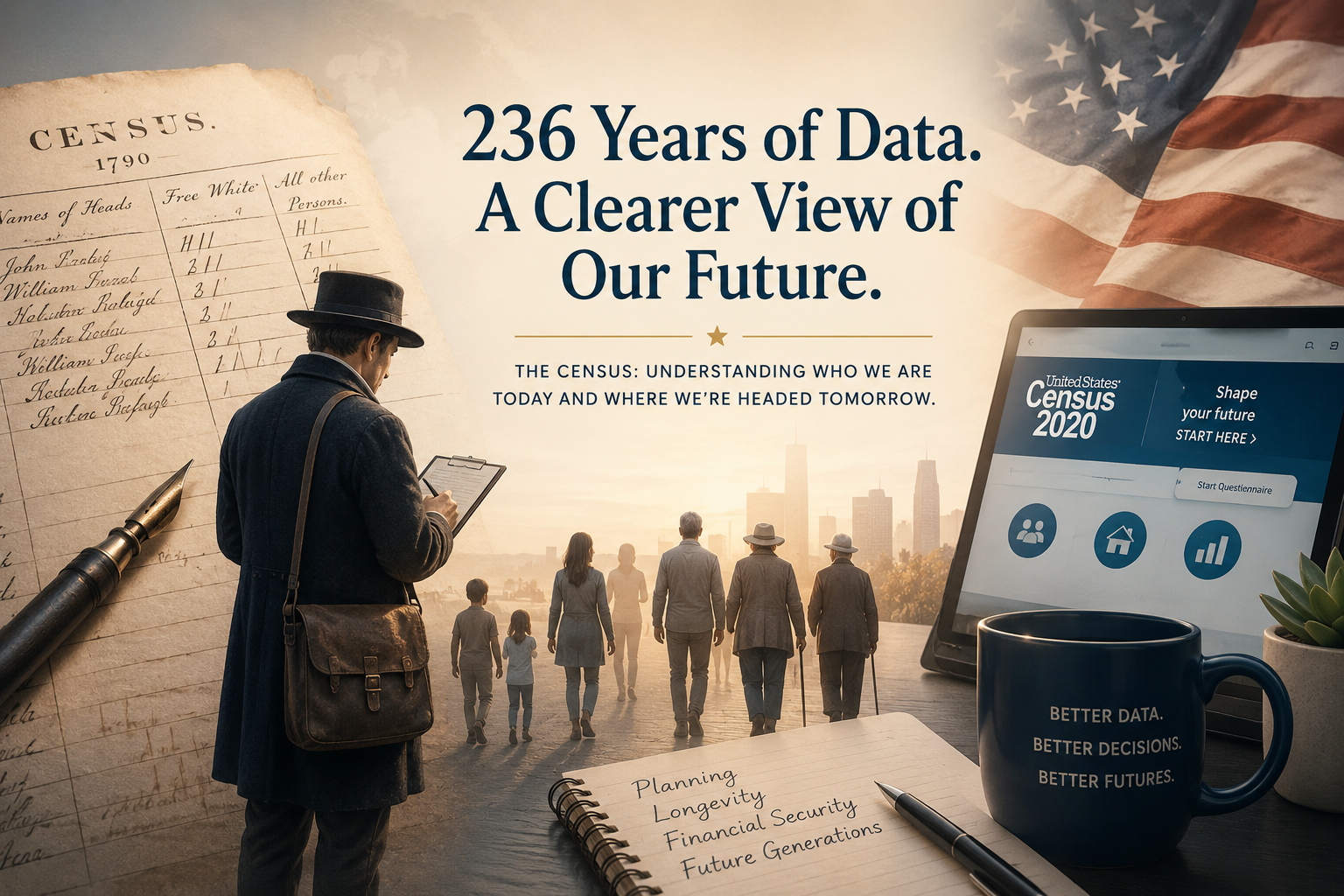
As America prepares to celebrate its 250th birthday, it's worth reflecting on one institution that has quietly documented the nation's journey almost from the very beginning—the U.S. Census.
Most people think of the census as a simple population count. In reality, it has always been much more than that. It captures how we live, how we work, where we move, what challenges we face, and how our society continues to evolve.
Thanks to a fascinating historical overview by Travis Shoemaker of the U.S. Census Bureau, I was reminded that the census has never been just about numbers. It has been a mirror reflecting America's changing story for more than two centuries.
A History of Asking Big Questions
The Census Act of 1790 was passed by the First Congress and signed by President George Washington. There were no printed forms or digital databases. Enumerators recorded information by hand on whatever paper they could find, and citizens who refused to cooperate could face a twenty-dollar fine.
Even then, collecting information wasn't always easy.
During the 1810 census, Congress sought manufacturing data because Napoleon's wars disrupted European imports. Business owners were hesitant to share information, and one North Carolina enumerator admitted the questions had created "jealousies" among many citizens.
By 1850, the census had become more organized, with the Department of the Interior overseeing tabulation. That same census revealed that the United States had surpassed the United Kingdom in population—a milestone that reflected the country's remarkable growth.
As the nation changed, so did the census.
Following the Civil War, the 1870 census provided the first comprehensive statistical portrait of Black Americans after emancipation. By 1880, women served as enumerators, Alaska was officially counted, and street names and house numbers became part of the national record.
The census wasn't simply documenting history—it was adapting alongside it.
Following America's Transformation
Over the decades, census questions evolved to reflect the realities of each generation.
During the Great Depression, Congress relied on the Census Bureau to measure unemployment and better understand the nation's economic crisis.
In 1940, census data helped inform America's Victory Plan during World War II while also collecting information about employment, income, pensions, Social Security, and retirement deductions.
That detail caught my attention.
Long before retirement planning became a mainstream conversation, the census was already gathering information about how Americans prepared for life after work.
In many ways, the seeds of today's retirement planning conversations were planted decades ago.
The Data Behind Better Decisions
Today's census is dramatically different from its handwritten beginnings.
In 2020, households across the country responded online during one of the most challenging periods in modern history. Satellite imagery helped update address records, and technology allowed millions of Americans to participate more efficiently than ever before.
But despite all the technological advances, the purpose remains unchanged.
The census helps us understand who we are becoming.
It reveals changing family structures, aging populations, migration patterns, workforce trends, housing needs, and shifting communities. Those insights influence everything from infrastructure and healthcare to education and public policy.
For professionals working in retirement, longevity, and financial planning, these demographic shifts are more than interesting statistics—they help shape the conversations we need to have with families today.
Looking Beyond the Numbers
One of the greatest lessons from 236 years of census history is that demographics are never static.
People are living longer.
Families look different than they did a generation ago.
Retirement often lasts 25 to 35 years rather than a decade.
Caregiving responsibilities continue to expand.
Women are inheriting unprecedented levels of wealth.
Each of these trends represents more than data points. They represent real people navigating increasingly complex financial and life decisions.
Understanding those changes allows us to plan more thoughtfully—not just for today's realities, but for tomorrow's.
Who Are We Becoming?
The census has always asked a deceptively simple question:
Who are we now?
Perhaps the more important question for each of us is this:
Who will we become?
Preparing for longer lives requires more than financial projections. It requires understanding the demographic, economic, and social forces reshaping retirement itself.
For more than two centuries, the census has helped America understand where it has been.
Its greatest value today may be helping us prepare for where we're going next.
Continue the Conversation
If you're interested in how longevity, demographic change, and evolving retirement realities are transforming financial planning, you'll find many of these ideas explored more deeply in my book, Leading in the New Retirement Era.
It's a practical guide for advisors, professionals, and families who want to prepare for the opportunities—and challenges—of longer lives and a changing future.