
What If We Designed Retirement Backwards—From What Matters Most?
Retirement Strategist Carroll Golden
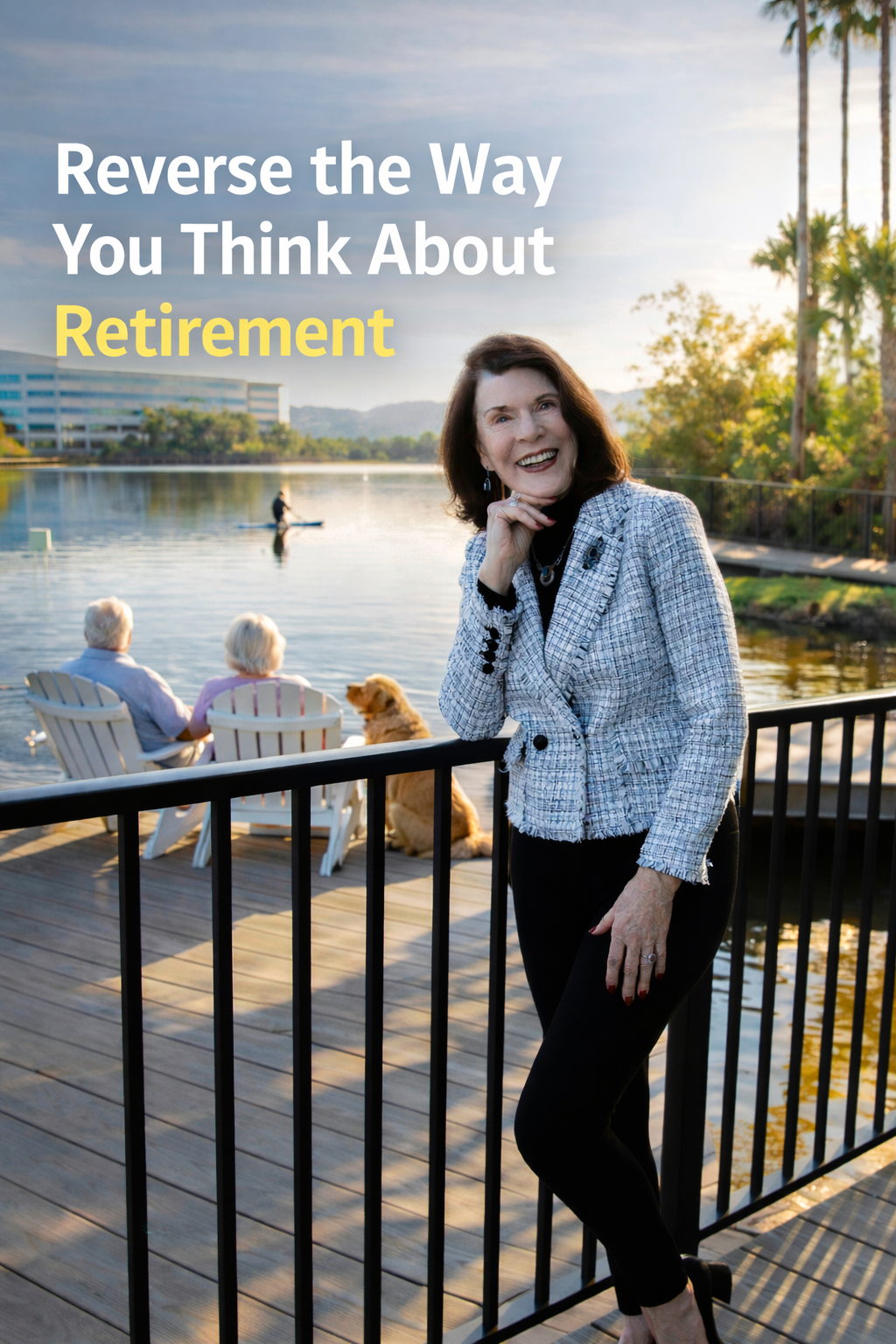
Reverse‑Engineering Retirement in an Age of Longevity
For today's (and tomorrow's clients) most retirement plans start in the wrong place.
They begin with calculators. Drawdown strategies. Asset allocations. Tax brackets.
And while those are essential—they’re not the foundation. They’re the scaffolding.
The real structure should come from a different question: What kind of life are you designing for in retirement?
Because if you don’t answer that first… You’re not planning. You’re just projecting.
The Problem With Forward-Only Planning
Traditional planning moves linearly:
Project the numbers
Optimize tax strategy
Layer in insurance or income
File away documents
What’s missing? Vision.
Retirement is not a math problem. It’s a life redesign. It’s a transition of identity, purpose, health, and relationships.
And when you only move forward—without zooming out—you risk building something accurate… but in many ways, meaningless.
That’s where reverse-engineering comes in.
And if there’s one person who helped me fully see the impact of this mindset, it’s Ernesto Verdugo
Ernesto doesn’t just ask “what’s next?” He asks, “What outcome are you trying to create—and how far back can we trace that line?”
That’s a question more advisors, families, and Retirement Synthesists™ should be asking.
What Does It Mean to Reverse-Engineer Retirement?
Instead of starting with the numbers, we start with the moment.
What do you want your life to feel like at 75?
What do you want to be able to say at 85?
Who do you want around you at 90—and how do you want to be remembered?
Then we work backward.
To live independently at 85, what support do you need at 70? To be financially secure and spiritually fulfilled at 80, what decisions must happen in your 60s?
Reverse-engineering forces clarity. It replaces vague goals with real-life design specs.
From Purpose to Planning: A Real Shift in Sequence
Here’s the shift:
Old Sequence
Income → Budget → Longevity Risk → Legacy Wishes → (Maybe) Purpose
New Sequence
Purpose → Health & Identity → Time Use → Care Requirements → THEN Money Strategy
You don’t just ask “How much do you need to retire?” You ask “What will your life require to be meaningful?” Then you build for that.
That’s the Retirement Synthesist model.
3 Core Questions to ask Clients to Reverse-Engineer Retirement
“Who do you want to be for others—and for yourself—in this next chapter?” Retirement isn’t an exit. It’s a reintroduction. Who’s showing up? What will it cost?
“What capacities must you protect or develop?” Energy, mobility, clarity, community, resources. What makes you you? —and now we can build a plan that protects that.
“If this phase of life is a gift, how do you avoid wasting it?” Time is now the most precious asset. How will you ensure your days aren’t filled with distraction or regret?
Reverse-engineering requires a different kind of intelligence—one that values integration over speed.
It’s not transactional. It’s not algorithmic. You can’t plug it into a calculator, and AI can’t auto-generate it on command.
Because you're not just running the numbers. You're synthesizing what those numbers need to make possible—across time, identity, relationships, and care.
This kind of planning demands perspective, not just precision. It means pausing long enough to connect what most people only measure.
It’s messy. It requires real questions, real values, real conversations. And for many professionals, that feels “out of scope.”
But for Retirement Synthesists, this is the job. Not just listing policies or products. But designing a plan that means something.

A Quick Story: The Reverse-Engineered Gift
A client once told me: “I don’t want my son to think I left him money. I want him to know I left him momentum.”
That changed everything.
She didn’t want her son to inherit assets. She wanted him to inherit momentum. She wasn’t optimizing wealth transfer. She was curating a living legacy—designed to keep shaping him long after she was gone.
We ended up reallocating part of her legacy into something very specific: a long-term gifting strategy that included mentorship, shared philanthropy, and memory-making.
No calculator could have told us that.
It only emerged when we reverse-engineered from the outcome she wanted to leave behind.
Conclusion: We Plan Better When We Start at the End
If you want a retirement plan that protects more than just your income, start with a sharper question:
What will matter most when you're no longer at the center of the story?
What will still echo when your role shifts—or disappears altogether?
What will the people you love most need—yes in dollars, but also in direction? Not just assets, but answers?
Not a spreadsheet. Not a product lineup. But a clear, human blueprint for what your life—and your portfolio—are meant to make possible.
Everything else—income, insurance, RMDs, LTC—is just the infrastructure and tools.
Reverse-engineering isn’t complicated. It’s just rare.
And it’s time we changed that.
We need more Retirement Synthesists™.
Schedule a conversation to begin designing your next chapter.